Table of Contents
ToggleBuilding or buying a tiny house comes with one non-negotiable challenge: where to sleep without sacrificing your entire floor plan. That’s where lofts come in. A well-designed loft transforms wasted vertical space into a functional bedroom, storage area, or multipurpose zone, all while keeping the ground floor open for living. Whether you’re planning a DIY build or retrofitting an existing tiny home, understanding loft design, structural requirements, and access options will determine how livable your space actually feels. This guide walks through the essentials of tiny house loft construction, from code compliance to creative configurations.
Key Takeaways
- A tiny house with loft reclaims vertical space to maximize ground-floor living areas, freeing up 25–40% of your main floor for kitchens, bathrooms, and functional zones.
- IRC Appendix Q requires a minimum 35-inch ceiling height over 50% of loft area, loft size capped at one-third of the main floor, guardrails at 36 inches high, and egress windows for sleeping lofts.
- Headroom and ventilation are critical: use cathedral roofs, skylights, or roof vent fans to achieve 3.5+ feet of loft headroom and prevent heat and moisture buildup.
- Choose between space-saving ladders, alternating tread stairs, or full stairs with under-stair storage to balance safety, accessibility, and floor space usage.
- Maximize under-loft storage with closets, pantries, knee-wall cubbies, and clear plastic bins, while adhering to weight limits and moisture prevention for structural integrity.
- Install smoke and carbon monoxide detectors in the loft, use low-profile RV-rated fixtures for lighting, and limit stored items to what you can safely carry up and down your access method.
What Makes a Loft Essential in Tiny House Design
In homes under 400 square feet, every square inch counts. A tiny house loft reclaims the upper third of your structure, space that would otherwise sit empty above your head. Most tiny homes have ceiling heights between 10 and 13.5 feet (the maximum for highway-legal trailers without special permits), giving you roughly 3 to 5 feet of usable vertical clearance in a loft.
Lofts free up ground-level square footage for kitchens, bathrooms, and living areas. Without one, a sleeping area would consume 25–40% of your main floor, forcing awkward furniture arrangements or eliminating functional zones entirely. By moving the bed up, you gain room for a dining table, workspace, or storage closet below.
From a structural standpoint, lofts also distribute weight efficiently. When built correctly over load-bearing walls or reinforced joists, they don’t compromise the integrity of a tiny home on wheels (THOW). In fact, many tiny home loft designs use the sleeping platform as a structural brace, tying side walls together and reducing lateral flex during transport.
That said, lofts aren’t universal. They require climbing (a dealbreaker for some), reduce headroom, and can feel claustrophobic if poorly ventilated. If mobility or accessibility is a concern, ground-floor sleeping arrangements or a convertible Murphy bed might be a better fit.
Popular Loft Configurations for Tiny Homes
Sleeping Lofts vs. Multi-Purpose Lofts
The most common tiny house loft plans fall into two categories: dedicated sleeping lofts and flexible multi-use platforms.
Sleeping lofts are typically 6 to 7 feet wide and run the full width of the house (usually 8 to 10 feet on a standard trailer). They sit above the bathroom or kitchen, with just enough headroom to sit up in bed, 36 to 42 inches of clearance is standard. These are purely for sleeping and maybe a bedside shelf. You won’t be standing or dressing up there.
Many designs incorporate a queen-size mattress (60 × 80 inches), though full or custom sizes work if you’re building from scratch. The key is leaving a 6-inch margin around the mattress for tucking sheets and avoiding a coffin-like feel. Some builders add a skylight or gable window directly above the bed for natural light and psychological relief.
Multi-purpose lofts sacrifice a bit of sleeping space for functionality. These might include a small desk nook, reading corner, or storage alcove at one end. To make this work, you’ll need at least 54 to 60 inches of headroom in the activity zone, enough to sit comfortably in a chair or crouch while organizing bins. This configuration works well in taller tiny homes or when the loft spans only part of the structure, leaving a vaulted ceiling over the main living area.
Another option is a split loft, with two separate platforms on opposite ends of the home. This works for couples who want separate office or hobby spaces, or for families with kids who need privacy. The downside? You lose the open, airy feel of a single vaulted space, and framing two lofts requires more lumber and labor.
Building Codes and Safety Requirements for Tiny House Lofts
Tiny houses occupy a gray area in building codes, but if you’re seeking a certificate of occupancy or parking on a foundation, expect scrutiny. The International Residential Code (IRC) Appendix Q covers tiny homes specifically, and loft requirements include:
- Minimum ceiling height of 35 inches over at least 50% of the loft floor area (measured from the finished floor to the finished ceiling).
- Loft area can’t exceed one-third of the main floor area below.
- Guardrails required if the loft edge is more than 30 inches above the floor below, with a minimum height of 36 inches and balusters spaced no more than 4 inches apart.
- Egress windows are often mandated for sleeping lofts, minimum 5.7 square feet of openable area, with at least 24 inches of width and 20 inches of height, and a sill height no more than 44 inches above the floor.
These rules vary by jurisdiction. Some counties waive egress requirements for lofts under a certain square footage: others enforce full bedroom standards. Check with your local building department before framing.
For THOWs, which are often classified as RVs, codes are looser but not nonexistent. The Recreational Vehicle Industry Association (RVIA) certification process includes loft safety checks: guardrails, weight capacity (typically 200 pounds per square foot for sleeping areas), and secure fastening to resist road vibration.
Safety tip: Install a smoke detector and carbon monoxide alarm in the loft. Heat and fumes rise, making lofts the first place deadly gases accumulate. Battery-powered units are fine, but hardwired interconnected alarms (so one triggers all) are safer if you’re on grid power.
Designing Your Loft Space: Headroom, Access, and Ventilation
The three biggest complaints about tiny house lofts? Can’t sit up, can’t breathe, and can’t get up there without risking a broken ankle. Here’s how to address each.
Headroom depends on your trailer bed height and ceiling pitch. A standard flatbed trailer sits 18 to 24 inches off the ground: add 6 inches for subfloor and framing, and your main floor starts at roughly 24 to 30 inches above the hitch. With a 13.5-foot overall height limit (for highway travel), subtract trailer height and main floor thickness, and you’re left with about 10 to 11 feet of interior height from floor to peak. If you set the loft floor at 6.5 feet, you get 3.5 to 4.5 feet of headroom below and 3.5 to 4.5 feet above, barely enough to kneel in bed.
One trick: use a cathedral or shed roof to push the loft toward the tall end of the slope. This gains you 6 to 12 inches of extra headroom where it counts. Another option is to build a dormer or pop-out over the loft, though this adds complexity, weight, and potential leak points.
Ventilation is critical. Lofts trap heat in summer and moisture in winter. At minimum, install an operable skylight or gable vent with a screen. A 12-volt RV roof vent fan (like a Fantastic Fan or MaxxAir) pulls hot air out and fresh air in, and runs off solar or house batteries. Position it near the loft’s peak for maximum airflow. Some builders add a mini-split heat pump ductless head in the loft, but that’s overkill unless you’re in extreme climates.
Ladder vs. Stairs: Choosing the Right Access Solution
This is the biggest trade-off in tiny house loft design. Ladders save floor space but are risky, especially at night or when carrying bedding. Stairs are safer and can double as storage but consume 10 to 16 square feet of precious ground-level area.
Fixed vertical ladders (like ship’s ladders) are the most compact, requiring only a 2 × 3-foot footprint. They’re cheap and easy to build from 2×4 rails and 1-inch dowels or metal rungs, but climbing them half-asleep is a recipe for a sprained ankle.
Alternating tread stairs (also called Jefferson stairs) are a middle ground. Each step alternates left and right, creating a steep but walkable ascent in about 3 feet of run. They feel safer than ladders and still leave room for storage underneath. Build them from 2×10 or 2×12 treads notched into a 2×12 stringer, with a 40- to 50-degree angle of ascent. Code typically requires a handrail on at least one side.
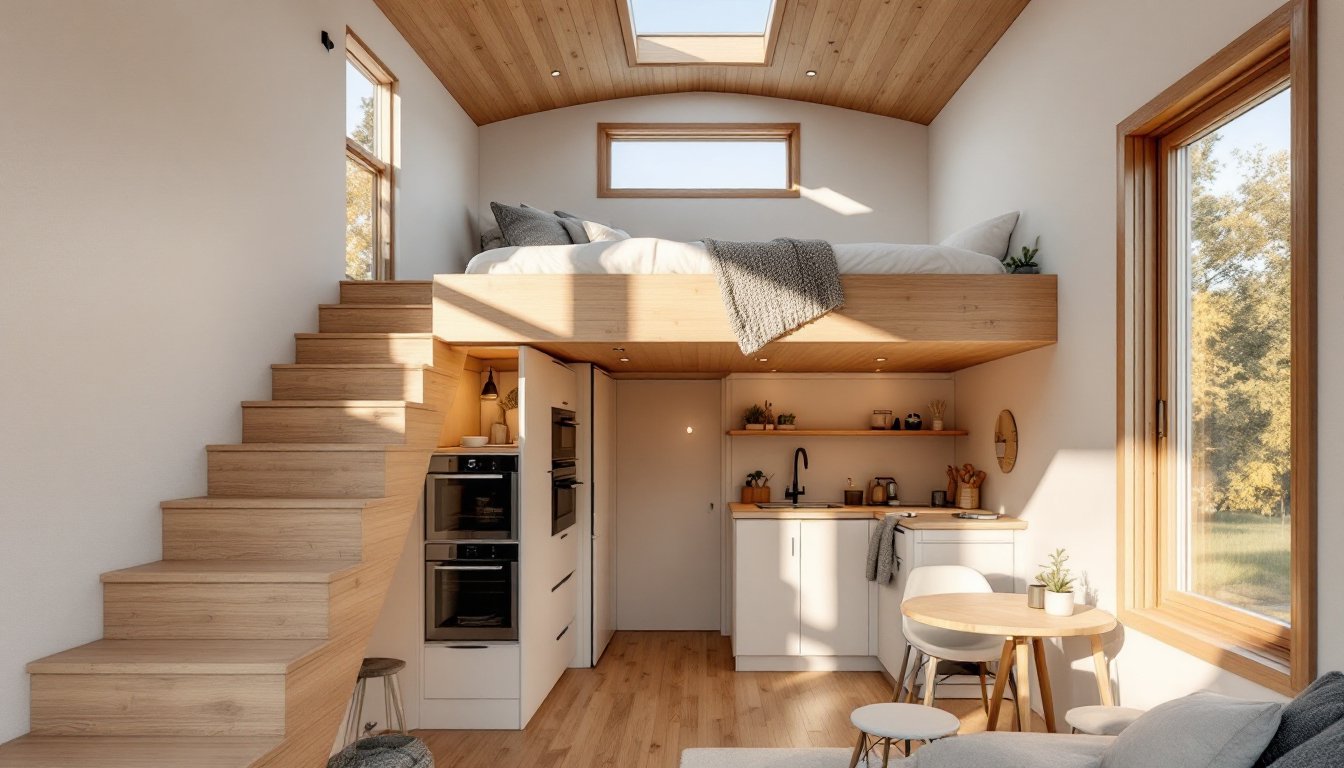
Full stairs with a standard 7-inch rise and 10-inch tread depth are the safest option, but they’ll eat up 5 to 8 feet of floor length. To make them worthwhile, every riser should have a pull-out drawer or cabinet door. Use 3/4-inch plywood boxes with full-extension drawer slides rated for 100 pounds or more. This is where many small space storage ideas come into play, incorporating vertical drawers, cubbies, and even a washer/dryer nook under the stairs.
Creative Storage Solutions Under and Around Your Loft
The space beneath a loft is a missed opportunity if you don’t plan ahead. Depending on loft height, you can fit a closet, pantry, bathroom, or combination workspace underneath.
If your loft floor sits at 6.5 feet, you have about 78 inches of clearance below, enough for a standard interior door (80 inches with frame). Frame a closet with a 2×4 wall and hang a bifold or sliding barn door to save swing space. Inside, install a tension rod for hanging clothes and stackable wire shelves for shoes and bins.
For lofts above kitchens, the underside becomes a natural pantry. DIY storage shelves using 1×12 boards and metal brackets can hold canned goods, spices, and dry ingredients. Keep heavier items on lower shelves to maintain a low center of gravity (critical for THOWs during transport).
Around the loft perimeter, use every inch of knee wall space. A knee wall is the short vertical wall where the roof slope meets the loft floor, usually 2 to 4 feet tall. Build shallow cubby boxes from 1/2-inch plywood and mount them between studs (16 inches on center). These are perfect for books, charging cables, glasses, and anything you need within arm’s reach of the bed.
Above the loft, if you have a few inches between the mattress and the ceiling, install a flush-mount LED panel light and a reading sconce on the wall. Avoid anything that hangs down, you’ll hit your head. Use low-profile fixtures (1 to 2 inches deep) designed for RVs or marine use.
One often-overlooked spot: the space between loft joists (if you have access from below). You can run wire baskets or fabric slings between joists to store rolled blankets, sleeping bags, or seasonal clothes. Just make sure nothing obstructs insulation or ventilation pathways.
Finally, if you’re working with a ground-level tiny home or a THOW parked semi-permanently, consider under-floor storage accessed from outside. Cut a hinged hatch in the subfloor (with weatherproof seals) and store tools, outdoor gear, or propane tanks below. This only works if your trailer has enough ground clearance and you’re not frequently moving, constant vibration will shake loose anything not strapped down.
For general decluttering strategies, it helps to adopt a one-in-one-out rule: every new item brought into a tiny home should replace an existing one. Lofts amplify clutter problems because everything you shove up there is out of sight, but still adding weight and chaos.
Pro tip: Use clear plastic bins instead of cardboard boxes in lofts. Moisture condenses in confined spaces, and cardboard molds quickly. Label bins on the short end so you can read them when stacked. And never store anything in a loft that you can’t safely carry up and down your ladder or stairs, a 50-pound bin is a back injury waiting to happen on an alternating tread staircase.