Table of Contents
ToggleSetting up a home theater doesn’t have to mean hiring a professional installer or dropping five figures. With the right speakers and a weekend of focused work, most homeowners can build a sound system that rivals dedicated media rooms. The challenge isn’t the installation, it’s wading through marketing jargon, configurations, and specs to figure out what actually fits the room, the budget, and the way the space will be used. This guide cuts through the noise and walks through speaker types, configurations, room-specific considerations, and the practical steps to get everything wired and calibrated without calling in a crew.
Key Takeaways
- Home theater speakers configured in 5.1 or 7.1 setups offer a balance of immersive sound and practical installation for most living rooms without excessive complexity.
- Room dimensions and acoustic properties directly determine speaker power, subwoofer size, and placement—measure your space and assess surface materials before purchasing.
- Floor-standing speakers work best for medium to large rooms, while bookshelf speakers provide flexibility for smaller spaces and surround channels when paired with a quality subwoofer.
- Proper subwoofer placement using the ‘subwoofer crawl’ method and AV receiver calibration are essential steps that deliver professional-quality audio without hiring an installer.
- Budget for cables, mounts, and stands alongside speakers, and use CL2/CL3-rated wire for in-wall installation to meet fire safety codes and local building requirements.
Understanding Home Theater Speaker Configurations
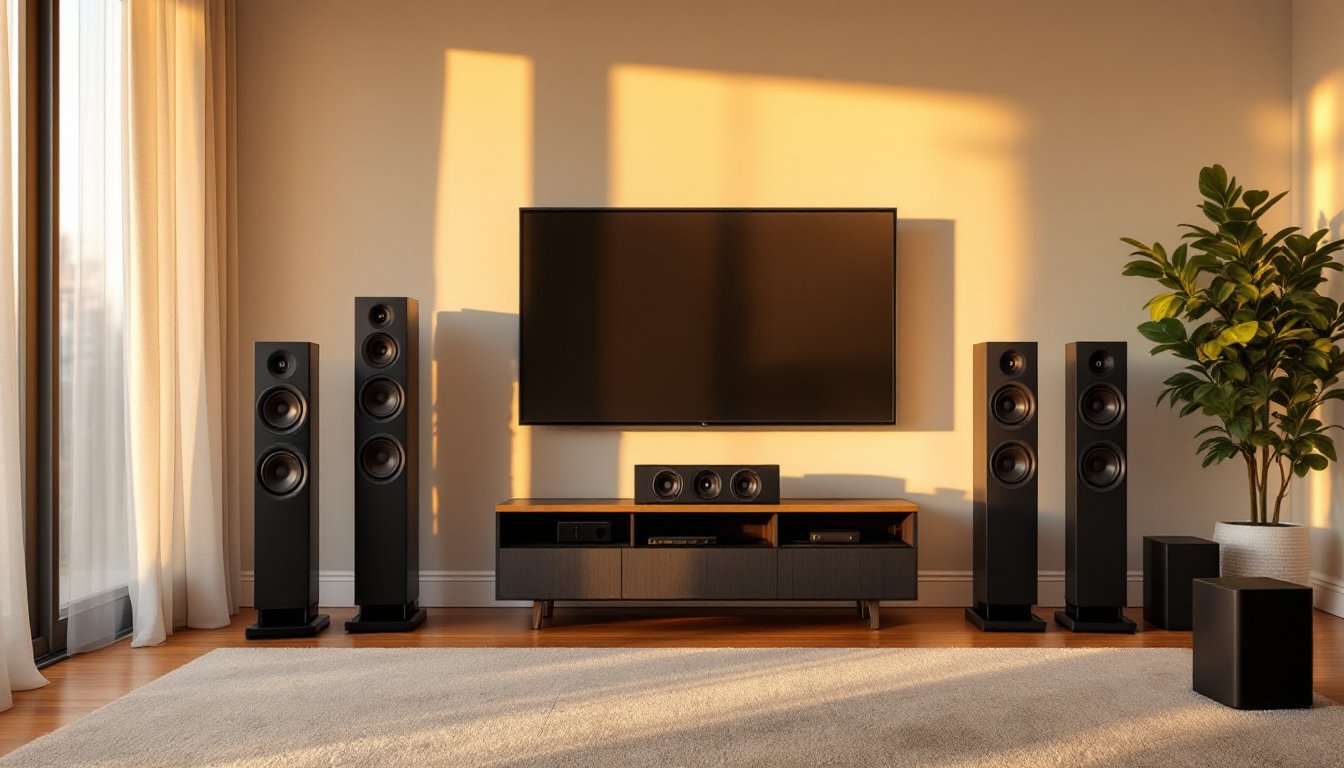
Home theater speaker systems are labeled with two numbers: the first indicates the number of main speakers, and the second refers to subwoofers. A 2.1 system includes two speakers (left and right) plus one subwoofer. A 5.1 setup adds a center channel and two surround speakers. The most common configurations are 5.1, 7.1, and 9.1, with higher numbers delivering more immersive sound at the cost of complexity and space.
For most living rooms under 300 square feet, a 5.1 configuration provides balanced audio without overwhelming the space. Larger rooms, especially those over 400 square feet or with open floor plans, benefit from 7.1 systems, which add rear surround speakers to fill dead zones. The 9.1 layout introduces height channels (ceiling or upward-firing speakers) for Dolby Atmos and DTS:X formats, but requires a compatible AV receiver and content mastered for object-based audio.
Atmos-enabled systems use a third number (e.g., 5.1.2 or 7.1.4), where the final digit represents height speakers. These ceiling or upfiring drivers create vertical sound layers, helicopters overhead, rain from above. It’s a noticeable upgrade for action films and gaming, but only if the room has at least an 8-foot ceiling and minimal acoustic interference from hard surfaces.
Before committing to a configuration, map out speaker placement on paper. The center channel sits directly above or below the screen. Left and right fronts flank the TV at ear height when seated, angled toward the primary listening position. Surrounds go to the sides or slightly behind the seating area, mounted 1-2 feet above ear level. Ceiling speakers for Atmos should be positioned above the front and rear seating zones, not directly overhead.
Types of Home Theater Speakers Explained
Choosing between speaker types comes down to room layout, aesthetic preferences, and how much flexibility is needed for future upgrades. Each category serves different use cases, and mixing types within a system is common.
Floor-Standing vs. Bookshelf Speakers
Floor-standing speakers (also called tower speakers) handle full-range audio without a subwoofer, though most setups still pair them with one for deeper bass. They’re ideal for front left and right channels in medium to large rooms. Expect each tower to stand 3-4 feet tall and weigh 30-60 pounds. They require floor space but eliminate the need for stands, and their larger drivers typically deliver cleaner midrange and more powerful low-end response than compact alternatives.
Bookshelf speakers are compact, versatile, and easier to position. Even though the name, they perform best on dedicated stands that place the tweeters at ear level, usually 36-42 inches off the floor for a standard couch. They’re a smart choice for surrounds, small rooms, or spaces where floor-standing towers would dominate visually. Bookshelf models need a subwoofer to fill out the low frequencies below 60 Hz, but many top home theater setups rely on high-quality bookshelf speakers for all channels except the sub.
When comparing the two, consider the room’s square footage and the ceiling height. Rooms under 200 square feet can get boomy with floor-standing fronts unless there’s acoustic treatment. Bookshelf speakers with an 8-inch or 10-inch subwoofer often sound tighter and more controlled in those spaces.
Soundbars and All-in-One Systems
Soundbars solve the setup problem by consolidating multiple channels into a single cabinet, often with a wireless subwoofer. They’re the fastest way to improve TV audio, requiring only an HDMI ARC or optical cable connection. Mid-tier soundbars simulate surround sound using digital processing and angled drivers, while high-end models add detachable wireless rear speakers for true discrete channels.
All-in-one systems bundle an AV receiver (or powered hub), speakers, and a subwoofer into a single package. These kits standardize component matching and simplify shopping, but they sacrifice flexibility, upgrading one component usually means replacing the entire system. They’re best for renters, first-time builders, or anyone who wants predictable results without researching individual drivers and crossover points.
For rooms with complex layouts, open kitchens, vaulted ceilings, or minimal wall space, a quality soundbar with wireless rears often outperforms a poorly placed traditional system. But in a dedicated media room with proper mounting options, discrete speakers and an AV receiver deliver superior imaging and dynamics.
How to Choose the Right Speakers for Your Space
Room dimensions directly impact speaker performance, and ignoring acoustics leads to muddy bass, harsh highs, and dialog that gets lost in the mix. Start by measuring the room’s length, width, and ceiling height. Multiply length by width to get square footage, this determines total speaker power and subwoofer size.
For rooms under 200 square feet, a system with 75-100 watts per channel and an 8-inch subwoofer provides clean volume without overpowering the space. Rooms between 200-400 square feet benefit from 100-150 watts per channel and a 10-inch or 12-inch sub. Spaces over 400 square feet may need dual subwoofers to even out bass response, especially if the room is rectangular or L-shaped.
Speaker sensitivity, measured in dB at 1 watt/1 meter, tells you how efficiently a driver converts power into sound. Speakers rated at 90 dB or higher work well with modest AV receivers (50-75 watts per channel). Models below 88 dB need more power to reach the same volume, which means a beefier amp and potentially higher electricity costs during long movie marathons.
Wall and ceiling materials matter. Drywall over studs reflects sound differently than concrete or brick. Hardwood floors and large windows create bright, reflective spaces that can make high frequencies sound harsh. If more than 40% of the room’s surfaces are hard and bare, add area rugs, curtains, or foam panels to absorb excess reflections. Acoustic treatment isn’t just for studios, it’s the difference between boomy, echo-prone audio and tight, clear dialogue.
Consider furniture placement early. The couch should sit roughly one-third to halfway into the room from the rear wall, not shoved against it. This creates space for surround speakers and prevents bass buildup at the back boundary. If the seating is fixed due to room layout, adjust the speaker distances in the AV receiver’s setup menu to time-align the sound.
Budget for cables, mounts, and stands alongside the speakers themselves. Quality 16-gauge speaker wire runs about $0.50-$1 per foot and should be long enough to avoid tight bends around baseboards. Wall mounts for surrounds cost $15-$40 per pair, and bookshelf speaker stands range from $50-$150 depending on height adjustability and cable management features.
Installation Tips for DIY Home Theater Setup
Running speaker wire through walls requires patience, the right tools, and awareness of local building codes. If fishing wire through finished drywall, use a stud finder to locate framing, electrical lines, and HVAC ducts before drilling. Most residential walls use 16-inch on-center stud spacing, but verify before cutting.
For in-wall wire runs, CL2-rated or CL3-rated speaker cable meets fire safety codes for enclosed spaces. Standard zip cord doesn’t, and using it can fail an inspection if one is required (check local regulations before opening walls). Use a flexible drill bit or fish tape to thread wire vertically between floors or horizontally through wall cavities. Always drill through the center of studs to avoid weakening structural framing.
If in-wall routing isn’t feasible, common in condos, apartments, or homes with concrete walls, use paintable cable raceways along baseboards and door frames. These low-profile channels keep wires tidy and protect them from foot traffic. Another option: flat speaker wire designed to run under carpet or along wall edges, though it’s more prone to damage and signal loss over long runs.
Mount surrounds and height speakers securely. For drywall installation, locate studs and use 3-inch wood screws driven into the framing, not just drywall anchors. Small bookshelf speakers under 15 pounds can hang on heavy-duty toggle bolts if studs aren’t available, but anything heavier risks pulling free over time. Many tested home theater systems include mounting brackets, but aftermarket options often offer better adjustability.
Subwoofer placement affects bass distribution more than any other speaker. Start by placing the sub at the main listening position (yes, on the couch), then play a bass-heavy test tone and walk around the room’s perimeter. The spot where the bass sounds loudest and most even is where the sub should go. This “subwoofer crawl” method works better than corner placement, which can cause boomy, one-note bass.
Once all speakers are positioned, run the AV receiver’s auto-calibration routine using the included microphone. This measures distance, level, and frequency response, then adjusts settings to balance the system. Most receivers (Denon, Yamaha, Onkyo) use proprietary calibration software (Audyssey, YPAO, AccuEQ). Run the calibration from the primary seating position, keeping the room quiet and the mic at ear height.
After auto-calibration, manually tweak levels if needed. Dialog should come clearly from the center channel without sounding disconnected from the action. If voices seem quiet, bump the center channel up 2-3 dB. If surrounds are too aggressive, reduce them by 1-2 dB. Small adjustments make a big difference, and there’s no single “correct” setting, personal preference and content type both matter.
Safety note: Always wear safety glasses when drilling overhead, and use a voltage tester near outlets or switches before driving screws into walls. If running wire near electrical lines or HVAC ducts, consult a licensed electrician to avoid code violations or fire hazards.
Conclusion
Building a home theater speaker system is well within reach for most DIYers willing to plan carefully and work methodically. The results, immersive audio that transforms movie nights and gaming sessions, justify the effort. Take time to measure, test placements, and calibrate properly, and the system will perform as well as many professional installations at a fraction of the cost.